
This project demonstrates how advanced materials engineering and precision off-site fabrication deliver faster, lighter, and more sustainable urban infrastructure solutions.
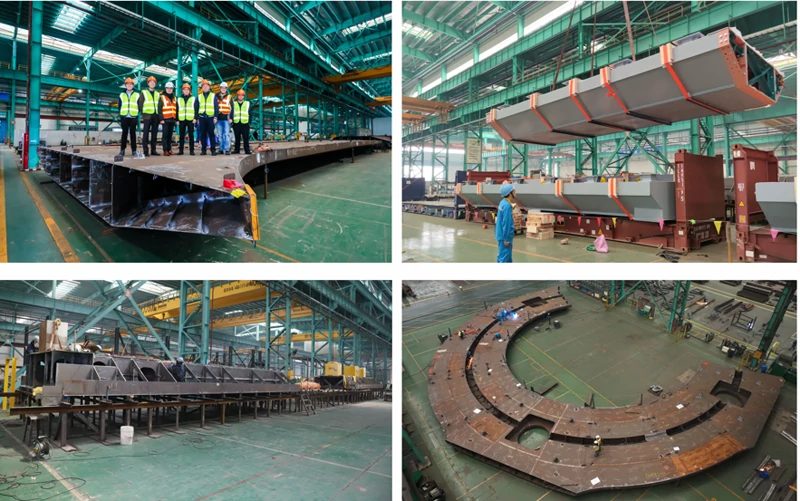
As cities accelerate urban renewal and sustainable infrastructure programs, pedestrian bridges are evolving from simple transport links into engineered landmarks. At the same time, municipalities and EPC contractors face increasing pressure to reduce structural weight, construction time, and carbon emissions.
Traditional steel bridge construction often struggles with:
The solution lies in a proven strategy: lightweight structural design enabled by ultra-high-strength steel (UHSS) combined with off-site precision fabrication.
We are pleased to announce the successful shipment of S960 ultra-high-strength steel pedestrian bridge components, marking a key milestone in advanced steel bridge manufacturing and sustainable urban construction.
S960 is a quenched and tempered structural steel with a minimum yield strength of 960 MPa, making it one of the strongest steels currently used in civil infrastructure projects.
For comparison:
This means S960 offers three to four times the strength of conventional structural steels while maintaining excellent toughness and fatigue resistance.
The use of S960 was driven by detailed engineering analysis and lifecycle optimization:
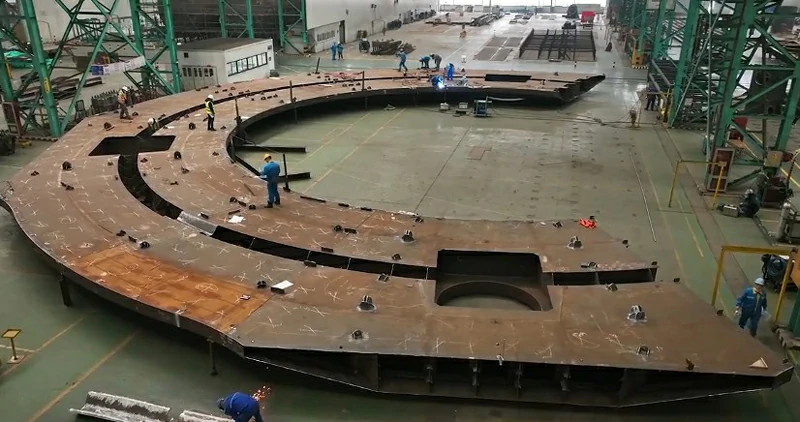
Ultra-high-strength steel delivers outstanding performance, but it also presents serious fabrication challenges, including springback during forming, weld crack sensitivity, and heat-affected zone (HAZ) softening.
Our engineering and production teams implemented a controlled, validated manufacturing process to ensure quality and repeatability.
Challenge: S960 steel is highly sensitive to heat input during cutting. Excessive thermal energy can reduce edge strength.
Solution: High-definition plasma cutting and multi-kilowatt fiber laser cutting systems. Through parameter optimization, cutting speed control, and gas flow tuning, the HAZ width was minimized, preserving base metal mechanical properties.
Challenge: High yield strength causes severe springback and requires high forming forces.
Solution: Large-capacity CNC press brakes and plate rolling machines, paired with proprietary springback compensation data derived from material testing. This approach ensured first-pass accuracy and precise final geometries for complex bridge components.
Challenge: S960 steel is susceptible to hydrogen-induced cold cracking and HAZ softening if welding parameters are not tightly controlled.
Solution: Our welding procedures were developed and validated according to international standards:
All welding work was performed by AWS D1.1 certified welders.
To ensure decades of service life in outdoor environments:
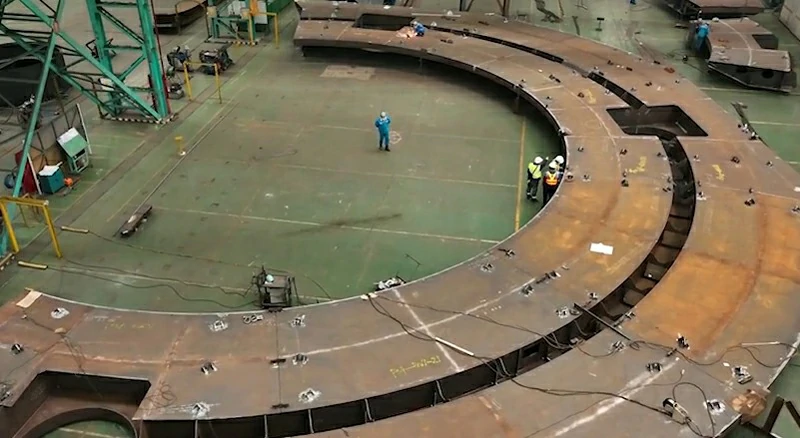
The success of this S960 pedestrian bridge project reflects our integrated manufacturing capabilities.
Production Equipment
Quality Assurance and Standards
By combining S960 ultra-high-strength steel with factory prefabrication, the project achieved measurable benefits:
This project confirms that S960 ultra-high-strength steel is a viable, efficient, and sustainable solution for modern pedestrian bridges and urban infrastructure.
As infrastructure owners and contractors increasingly prioritize lighter structures, faster delivery, and lower environmental impact, the combination of high-performance materials, precision fabrication, and modular construction will define the future of steel bridge engineering.
We are ready to support your next project.
We provide end-to-end fabrication solutions for infrastructure, industrial, and special steel structures, including:
Have drawings? Let’s talk.
📧 RFQ & Technical Inquiries: [sales3@openex.com.cn]
Contact us today to achieve lighter, stronger, and more sustainable steel structures.