
When manufacturing small components, the orientation of the machining process is rarely a logistical crisis. However, when you step into the world of heavy fabrication—dealing with parts that weigh 50 tons or span 5 meters in diameter—physics takes over.
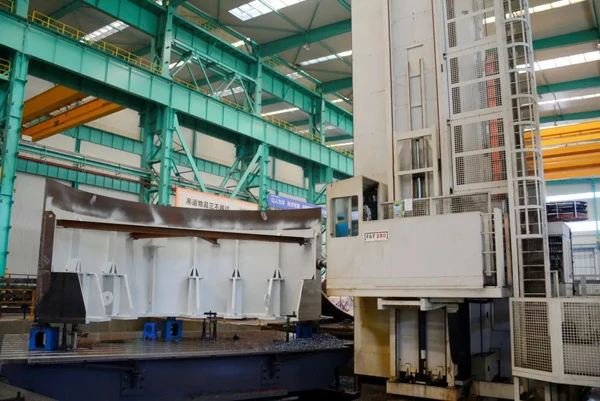
At Openex, we frequently guide procurement managers and engineers through the decision-making process for manufacturing large-scale rotational parts. Two primary methods dominate this field: Heavy Horizontal CNC Turning and Vertical Boring (VBM/VTL).
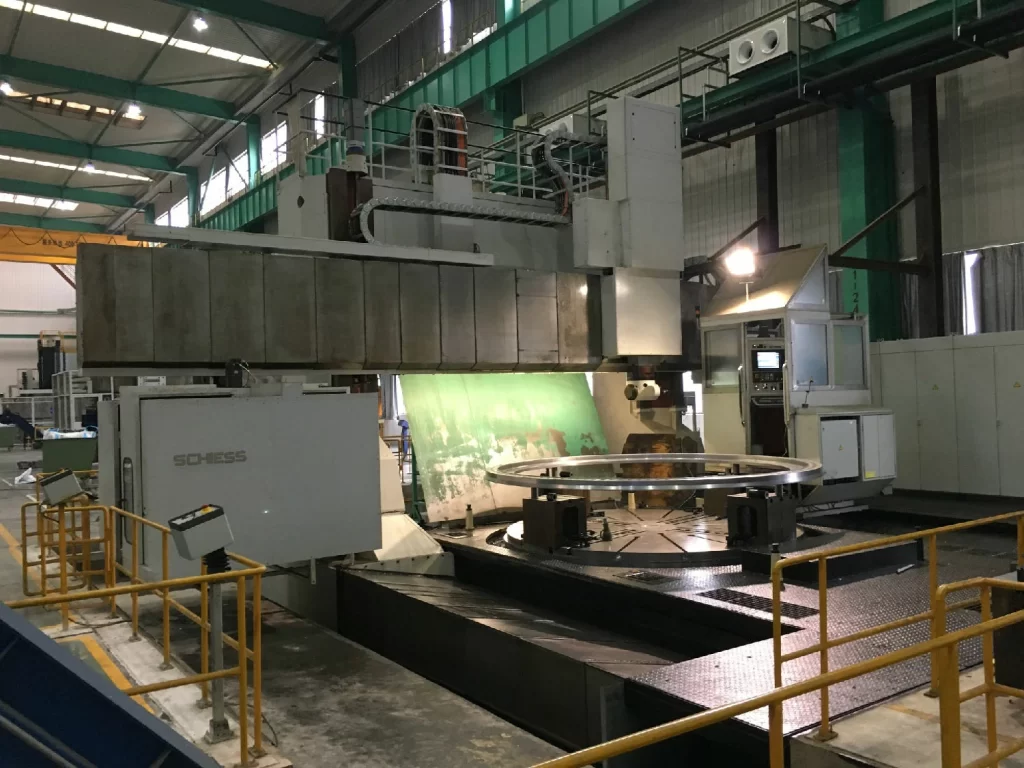
While both processes remove metal to create cylindrical shapes, selecting the incorrect one for your specific component can result in tolerance issues, deformation, or unnecessary costs. Here is a breakdown of how we determine which machine is best suited for your project.
The single biggest factor in large-scale machining is gravity.
In a standard horizontal lathe, the workpiece is clamped at one end (chuck) and supported at the other (tailstock), often with steady rests in the middle. For a long, slender part like a ship’s propeller shaft, this is ideal. However, if you try to spin a massive, heavy ring horizontally, gravity pulls the suspended weight downward. This causes the part to "sag" or ovalize while it spins, making it nearly impossible to hold tight circular tolerances.
This is where the Vertical Boring Mill (VBM)—often called a Vertical Turret Lathe (VTL)—shines.
On a vertical boring mill, the workpiece sits on a rotary table that spins like a potter’s wheel. The cutting tool descends from a gantry above.
Best Applications:
Large Flanges & Rings: Wind tower flanges, bearing rings, and slew bearings.
Heavy, Short Cylinders: Turbine housings, pump casings, and valves.
Asymmetrical Parts: Heavy parts that are difficult to balance horizontally.
The Advantages:
Eliminating Sag: Because the part rests flat on the table, gravity works with the clamping system, not against it. The part maintains its natural shape, allowing for superior roundness and flatness.
Easier Loading: Loading a 40-ton casing onto a horizontal lathe is a rigging nightmare. Loading it onto a vertical table with an overhead crane is safer and faster.
Massive Capacity: At Openex, our large-scale vertical boring capabilities allow us to machine diameters that would be impossible on a horizontal lathe.
While vertical mills handle the wide and heavy, Heavy Duty Horizontal Lathes handle the long and slender.
Best Applications:
Propeller Shafts: For the marine industry.
Rollers: For paper and steel mills.
Tie Rods & Columns: For heavy presses.
The Advantages:
| Feature | Vertical Boring (VTL/VBM) | Horizontal Turning |
| Primary Part Shape | Disc, Ring, Short Cylinder | Shaft, Tube, Long Roller |
| Gravity Effect | Stabilizes the part (Safe) | Can cause sagging (Requires support) |
| Clamping Pressure | Lower (Gravity helps hold it) | Higher (Must fight gravity/centrifugal force) |
| Ideal Industries | Wind Energy, Hydro Power, Oil & Gas | Marine, Paper & Pulp, Steel Mills |
Many smaller machine shops only have one type of machine. If they only have a horizontal lathe, they will try to force your large ring onto it, risking quality.
At Openex, we operate as a true one-stop shop. Our facility is equipped with both massive floor-type boring mills and heavy-duty horizontal lathes, alongside our fabrication and welding divisions.
We analyze your drawing, calculate the weight and dimensions, and route your part to the machine that ensures the tightest tolerances and the most efficient cycle time.
Do you have an oversized project requiring precision machining?
Don't let gravity ruin your tolerances. Contact Openex today for a technical review and a competitive quote.