
Waterjet (water-jet or liquid-jet) cutting is a nontraditional separation process to get a part size required. Under high pressure generated by an intensifier pump, water jet has the ability to erode not only plastic or wood, but also steel with very high hardness. To enhance the cutting capability, we usually add abrasive particles to the water and get a liquid mixture called abrasive jet, which is distinguished from pure waterjet cutting or water-only cutting.
Based on the working principle, waterjet cutting has advantages of no heat-affected zone (HAZ) and smooth cutting section area, and can be applied to nearly unlimited materials with a wide range of thickness. For example, laser cutting is not suitable for pure aluminum as it will reflect the light beam and has the potential to cause damage to the laser itself, but waterjet cutting has no problem for such a task.
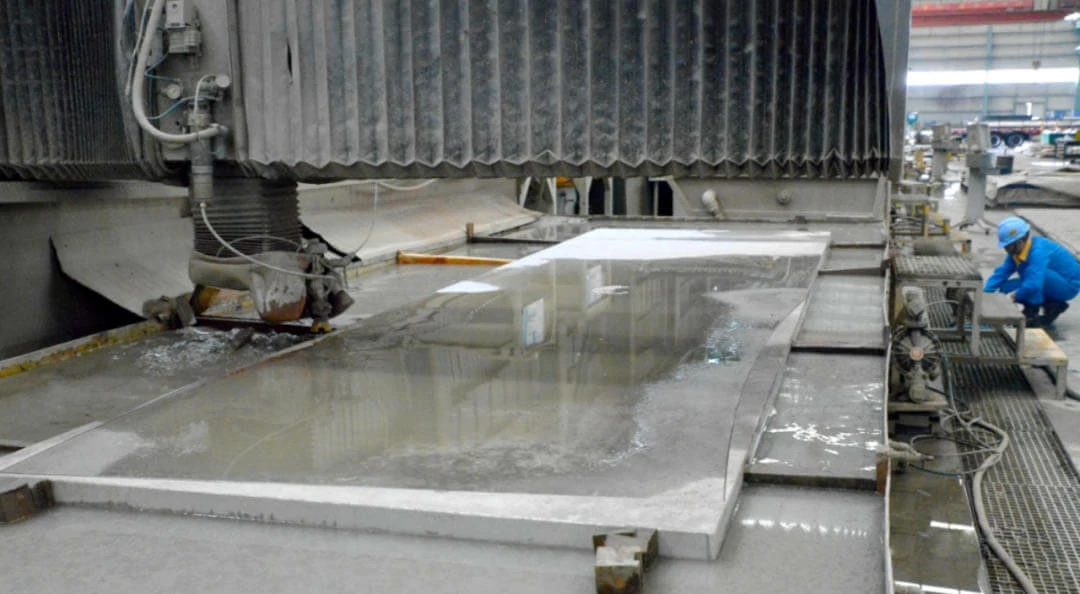
According to its principle and characteristics, waterjet cutting especially suits heat-sensitive, delicate or very hard materials. The ultra-high pressure liquid jet, coming through the jewel orifce, can be used for not only cutting, but also shaping and reaming.
We can control the kerf or width by swapping parts in a nozzle or changing the type or size of abrasive. Usually, the attaining accuracy is 0.13mm (0.005 inches), and the repeatability is 0.025mm (0.001 inches). The distance between nozzle and workpiece surface, typical 3.2mm (0.125 in), is also very important, as it will affect the kerf size and removal rate.
As the liquid is focused into a cone-shaped beam, there will be a taper less than 1 degree at the workpiece edge after cutting. This can be reduced or eliminated by slowing down or tilting the jet. The edge quality is ranked from Q1, the roughest, to Q5, the finest.
The capability parameters of our waterjet cutting are as below.
Max. thickness: 200 mm
Max. width: 4010 mm
Max. length: 12000 mm
Obviously, waterjet cutting is not suitable for every case. The main drawback is low speed resulting in high cost. So, for thin metal sheets, and cost-sensative parts made by thick boards where smooth cutting surface is not mandatory, laser and flame cutting are better choices respectively.
As the most popular multi-axis waterjet, 5-axis means X, Y, Z axis plus A and C axis, which indicate that the nozzle can tilt an angle and rotate around Z axis. Besides normal waterjet cutter handling metal sheets or plates, we can also separate and remove material from 3D surface by 5-axis waterjet cutting, which is much costlier correspondly.
The 5-axis is useful for weld preparation, as we can bevel angle on all sides, or make taper compensation. We can also process complicated parts which already existed by our 5-axis cutter.
Some of the typical examples of waterjet cutting are introduced as below.
The steel sheet is used for decoration. As the thickness is 5mm but the narrowest edge is only 2.5mm, it is extremely difficult to hollow out the required pattern without the occuring of heat deformation.
The carbon steel plates, with thickness 22-40mm, should be assembled after cutting. So, we choose waterjet cutting, instead of flame cutting, which requires further machining after that.
Made of super dual-phase (or duplex) stainless steel (DSS), the bar used for electrostatic eliminator. In order to achieve good performance in eliminating static electricity, the triangle tips on two sides should be within accuracy 0.2mm. We succeeded in making it by controlling the speed of the waterjet cutter.
Our Sweden-imported WJS 5-axis waterjet cutter, with platforms of 4200mm×6700mm, makes it possible to cut a hole of 350mm in diameter on the cylindrical surface of a steel tube of 900mm in diameter, 2300mm in length and 2.8 tons in weight. As the cutting path is not a planar curve, we controlled the tilting and rotating of the cutter to achieve the challenging task.
The manufacturing cost for waterjet cutting is proportional to the path length of jet nozzle. So, we can roughly estimate the cost by the edge length of a workpiece. For thicker material, the cost is higher, but not in proportion. The cost rate for 5-axis waterjet cutting is much higher than that of a normal type.
For customers’ benefit, we can combine several different workpieces in one cutting job within the scope of our large platform, and reduce the scrap to minimal. This can reduce material consumed, thus decrease the total cost correspondly.
Of course, waterjet cutting is not always the best choice in many circumstances, as the manufacturing cost is usually higher than that of flame cutting, laser cutting or plasma cutting. But we should put the CNC machining which may be needed after cutting into consideration and get a conclusion, which makes the total cost lowest to a certain workpiece.
Besides waterjet cutting, if you want to know more about other cutting means we can provide, please refer to the articles below.
Flame Cutting or Torch Cutting
Laser Cutting or Fiber Cutting
Plasma Cutting