
As a seasoned metal fabrication expert with over two decades of experience, I've witnessed numerous technological advancements in our industry. However, the introduction of laser welding robots stands out as a true game-changer. In this article, I'll dive deep into the world of laser welding robots, explaining their significance, components, applications, and impact on the metal fabrication industry.
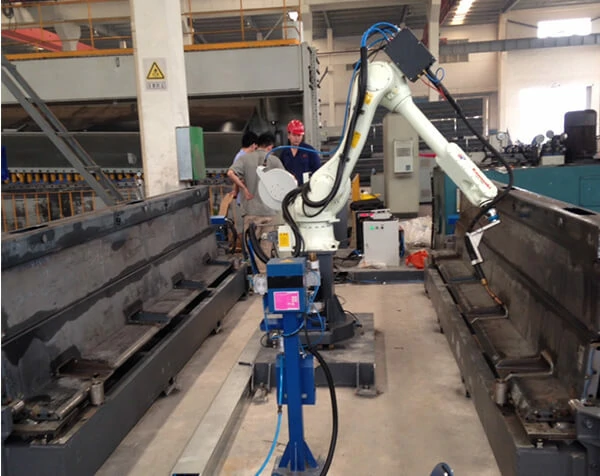
Laser welding robots represent the pinnacle of precision welding technology. These sophisticated machines combine the power of focused laser beams with the flexibility and accuracy of robotic arms. The result is a welding system that can produce high-quality, consistent welds at speeds traditional methods can't match.
a) Robotic Arm: The backbone of the system, typically featuring six or more axes of movement. This multi-joint design allows for complex 3D movements, enabling the robot to weld in virtually any position or angle.
b) Laser Source: The heart of the system. Common types include fiber lasers, CO2 lasers, and disk lasers. Each has its strengths, but fiber lasers are becoming increasingly popular due to their efficiency and reliability.
c) Optical System: A series of mirrors, lenses, and a focusing head that directs and concentrates the laser beam onto the workpiece. The ability to focus the beam into a tiny spot is crucial for achieving high energy density.
d) Control System: The brains of the operation. Advanced software and hardware work together to coordinate the robot's movements, control laser output, and manage welding parameters in real-time.
e) Sensing Systems: Various sensors, including vision systems and seam trackers, allow the robot to adapt to slight variations in the workpiece or welding conditions.
The laser welding process is fascinating from a metallurgical perspective. Here's how it works:
a) Beam Generation: The laser source produces a high-energy beam.
b) Beam Delivery: The optical system guides and focuses the beam onto the workpiece.
c) Melting: The intense, focused energy rapidly melts the metal at the weld joint.
d) Weld Pool Formation: A small, controlled melt pool forms.
e) Solidification: As the laser moves along the weld path, the molten metal behind it solidifies, creating the weld.
f) Shielding: In many cases, a shielding gas (like argon) is used to protect the weld pool from atmospheric contamination.
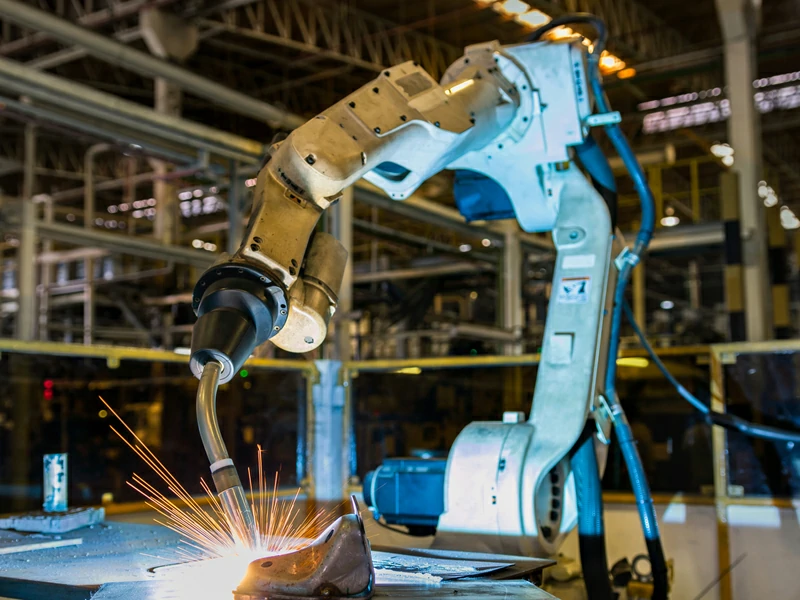
As a fabricator, I've found numerous benefits to using laser welding robots:
a) Precision: Welds can be placed with accuracy down to fractions of a millimeter. This is crucial for complex parts or when working with thin materials.
b) Speed: Depending on the application, laser welding can be 2-10 times faster than traditional welding methods.
c) Consistency: Once programmed, the robot produces identical welds repeatedly, which is excellent for quality control and reducing rework.
d) Minimal Heat Affected Zone (HAZ): The focused energy means less heat spreads through the workpiece, reducing distortion and maintaining material properties.
e) Versatility: These systems can weld a wide range of materials and thicknesses, often without filler material.
f) Automation Potential: Laser welding robots integrate well with other automated systems, paving the way for fully automated production lines.
In my experience, laser welding robots have found homes in numerous industries:
a) Automotive: Used for body-in-white assembly, powertrain components, and battery enclosures for electric vehicles.
b) Aerospace: Precision welding of turbine components, fuel systems, and structural elements.
c) Electronics: Micro-welding for batteries, sensors, and other delicate components.
d) Medical Devices: Creating sterile, high-strength welds for surgical instruments and implants.
e) Energy Sector: Welding pipes, pressure vessels, and renewable energy components like solar panel frames.
While laser welding robots offer numerous advantages, they're not without challenges:
a) Initial Cost: The upfront investment can be significant. However, I've found that the long-term benefits often outweigh this initial hurdle.
b) Programming Complexity: Creating efficient welding paths and optimizing parameters requires skill. Thankfully, offline programming software and simulation tools are making this process more accessible.
c) Material Preparation: Laser welding typically requires clean, precisely fitted joints. We've implemented advanced cleaning processes and improved fixturing to address this.
d) Safety Considerations: Working with high-power lasers necessitates robust safety protocols. We use enclosed welding cells, interlocks, and proper personal protective equipment (PPE) to ensure operator safety.
For shops considering laser welding robots, I recommend the following:
a) Start with a Clear Use Case: Identify specific applications where laser welding can provide the most benefit.
b) Invest in Training: Ensure your team is well-versed in programming, operation, and maintenance of the system.
c) Optimize Your Workflow: Consider how the laser welding robot will integrate with your existing processes.
d) Plan for Maintenance: Regular calibration and maintenance are crucial for consistent performance.
The field of laser welding robotics is constantly evolving. Some exciting trends I'm watching include:
a) AI and Machine Learning Integration: These technologies enable smarter, more adaptive welding processes.
b) Increased Power and Efficiency: Laser sources are becoming more powerful and energy-efficient.
c) Hybrid Systems: Combining laser welding with other processes (like arc welding) for even greater versatility.
d) Additive Manufacturing Integration: Some systems can now handle welding and 3D metal printing.
As a metal fabrication expert, We are truly excited about the potential of laser welding robots. They're not just tools; they're transforming how we approach metal joining. While they require investment in both equipment and expertise, the payoff in terms of quality, speed, and capabilities is immense.
For shops looking to stay competitive in an increasingly high-tech landscape, laser welding robots are becoming less of a luxury and more of a necessity. As we move forward, we expect these systems to become even more intelligent, efficient, and integral to modern metal fabrication.
Interested in our robot welding service or more information about our welding capabilities? Contact us now at sales3@openex.com.cn