
In the world of precision manufacturing, the spotlight usually falls on the micron-level tolerances of a finished part. But when that part weighs 50 tons and spans 10 meters, the challenge isn’t just cutting the metal—it’s moving it.
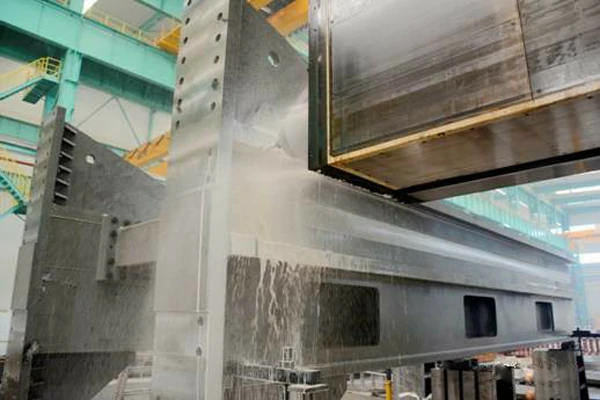
For procurement managers sourcing contract manufacturing in China, the logistics of handling oversized components is often a major source of anxiety. How do you move a massive raw casting without cracking it? How do you flip a 30-ton weldment to machine the other side? How do you ship it across the ocean without it rusting?
At Openex, we believe that heavy machining logistics is just as much an engineering discipline as the machining itself. Here is a behind-the-scenes look at the journey of a massive component through our facility.
The process begins long before the first chip is cut. When a raw casting or forging arrives at our facility—often for the mining or hydropower industries—it can weigh anywhere from 20 to over 100 tons.
Standard forklifts are useless here. Openex is equipped with heavy-duty overhead crane systems with lifting capacities exceeding 50 tons (with tandem lifting capabilities for even heavier loads).
The Critical Step: Incoming Inspection
Before we lift a finger to machine, we must ensure the raw material is sound. Moving a massive casting requires a dedicated rigging plan. Our certified riggers inspect lifting lugs and determine the center of gravity to ensure a safe lift. Once offloaded, the raw part undergoes immediate dimensional and visual inspection to ensure sufficient "stock" material is present for machining.
The most dangerous time for a heavy part is not when it’s being cut, but when it’s being moved. A complex housing or frame might need to visit multiple stations:
Stress Relieving: Moving to our large-scale heat treatment furnaces.
Sandblasting: Transporting to surface preparation booths.
Machining: Loading onto our heavy-duty floor borers or gantry mills.
Flipping the Unflippable
Many large parts require machining on multiple faces. Flipping a 40-ton asymmetrical part is a high-stakes operation. We utilize specialized welding positioners and rotators, as well as engineered turning fixtures. This allows us to rotate massive components safely and precisely, preventing damage to the part (and protecting our team) while ensuring we don't induce new stresses into the metal.
Once the part is machined to precision, validated by our CMM inspection, and painted, it faces its final adversary: the ocean.
Transporting oversized machined parts from China to Europe, Australia, or the Americas involves weeks at sea in a high-humidity, saline environment. Standard packaging is a recipe for a rusted, rejected part upon arrival.
Openex employs a rigorous export packaging protocol for heavy cargo:
Anti-Corrosion Science: We utilize VCI (Vapor Corrosion Inhibitor) films and desiccants that create a chemical barrier against moisture. For critical machined surfaces, we apply heavy-duty rust preventatives that the customer easily removes but are impenetrable to salt spray.
Vacuum Sealing: For sensitive equipment, we foil-bag and vacuum seal the entire component.
Custom Steel Skids: Wood pallets crush under 50 tons. We fabricate custom structural steel skids designed specifically for the footprint and weight distribution of your part. This ensures that when the crane lifts the skid, the machined part experiences zero torque or twisting forces.
How does it leave the factory?
Open Top / Flat Rack Containers: For parts that fit within standard width/length but are too heavy or tall for standard boxes, we load them into Open Tops or secure them to Flat Racks using heavy-duty lashing chains.
Break Bulk: For the truly massive components (exceeding container dimensions entirely), we coordinate Break Bulk shipping. We transport the item directly to the port on low-bed trailers, where it is lifted individually into the ship’s hold.
We don't just have big machines; we have the infrastructure to feed them. When you choose Openex, you aren't just buying CNC time. You are buying a complete logistical solution that safeguards your investment from the moment the raw material arrives until it lands safely at your site.
Do you have a project that is too heavy or awkward for your local shop?
Let us handle the weight. Contact Openex for a consultation on your large-scale manufacturing needs.
Contact Us for Heavy Fabrication Support
When manufacturing small components, the orientation of the machining process is rarely a logistical crisis. However, when you step into the world of heavy fabrication—dealing with parts that weigh 50 tons or span 5 meters in diameter—physics takes over.
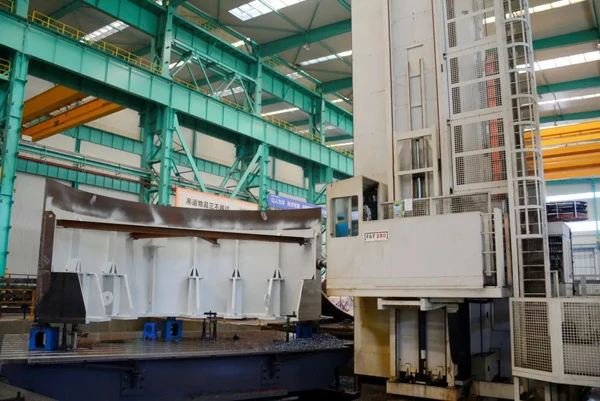
At Openex, we frequently guide procurement managers and engineers through the decision-making process for manufacturing large-scale rotational parts. Two primary methods dominate this field: Heavy Horizontal CNC Turning and Vertical Boring (VBM/VTL).
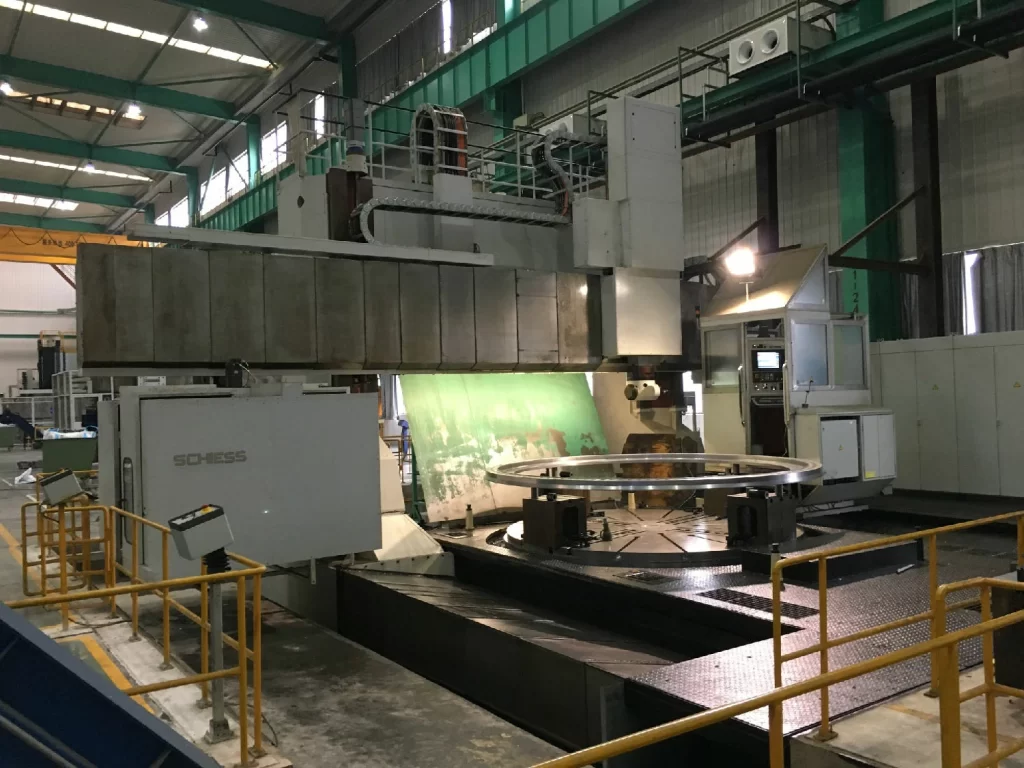
While both processes remove metal to create cylindrical shapes, selecting the incorrect one for your specific component can result in tolerance issues, deformation, or unnecessary costs. Here is a breakdown of how we determine which machine is best suited for your project.
The single biggest factor in large-scale machining is gravity.
In a standard horizontal lathe, the workpiece is clamped at one end (chuck) and supported at the other (tailstock), often with steady rests in the middle. For a long, slender part like a ship’s propeller shaft, this is ideal. However, if you try to spin a massive, heavy ring horizontally, gravity pulls the suspended weight downward. This causes the part to "sag" or ovalize while it spins, making it nearly impossible to hold tight circular tolerances.
This is where the Vertical Boring Mill (VBM)—often called a Vertical Turret Lathe (VTL)—shines.
On a vertical boring mill, the workpiece sits on a rotary table that spins like a potter’s wheel. The cutting tool descends from a gantry above.
Best Applications:
Large Flanges & Rings: Wind tower flanges, bearing rings, and slew bearings.
Heavy, Short Cylinders: Turbine housings, pump casings, and valves.
Asymmetrical Parts: Heavy parts that are difficult to balance horizontally.
The Advantages:
Eliminating Sag: Because the part rests flat on the table, gravity works with the clamping system, not against it. The part maintains its natural shape, allowing for superior roundness and flatness.
Easier Loading: Loading a 40-ton casing onto a horizontal lathe is a rigging nightmare. Loading it onto a vertical table with an overhead crane is safer and faster.
Massive Capacity: At Openex, our large-scale vertical boring capabilities allow us to machine diameters that would be impossible on a horizontal lathe.
While vertical mills handle the wide and heavy, Heavy Duty Horizontal Lathes handle the long and slender.
Best Applications:
Propeller Shafts: For the marine industry.
Rollers: For paper and steel mills.
Tie Rods & Columns: For heavy presses.
The Advantages:
| Feature | Vertical Boring (VTL/VBM) | Horizontal Turning |
| Primary Part Shape | Disc, Ring, Short Cylinder | Shaft, Tube, Long Roller |
| Gravity Effect | Stabilizes the part (Safe) | Can cause sagging (Requires support) |
| Clamping Pressure | Lower (Gravity helps hold it) | Higher (Must fight gravity/centrifugal force) |
| Ideal Industries | Wind Energy, Hydro Power, Oil & Gas | Marine, Paper & Pulp, Steel Mills |
Many smaller machine shops only have one type of machine. If they only have a horizontal lathe, they will try to force your large ring onto it, risking quality.
At Openex, we operate as a true one-stop shop. Our facility is equipped with both massive floor-type boring mills and heavy-duty horizontal lathes, alongside our fabrication and welding divisions.
We analyze your drawing, calculate the weight and dimensions, and route your part to the machine that ensures the tightest tolerances and the most efficient cycle time.
Do you have an oversized project requiring precision machining?
Don't let gravity ruin your tolerances. Contact Openex today for a technical review and a competitive quote.